.png?width=1075&height=150&name=Trustpilot%20Banner%20(8).png)
Please download and complete the Cost Prices Spreadsheet.
You’ll have a task on your Tribexa dashboard where you can upload the finished spreadsheet. If you add new products to your range, we’ll add a task to your Tribexa dashboard requesting you update the information.
Download the Cost Prices Spreadsheet
We have to have this information to complete your VAT returns. Please fill it in and upload it to Tribexa as soon as you can. Delays can result in penalties from the Tax Authorities.
When you'll be invoiced
Now that your registration is complete, we'll begin issuing invoices for your monthly subscription. Our invoices are charged on the 1st of each month, based on the work we do for the previous reporting period. For example, if you need to file March's VAT return, you'll see the charge on April 1st. This is because we finalise and submit the necessary work in April.
Your monthly subscription fees will be charged to your payment method through Stripe on the 1st of each month. After the payment is processed, you will automatically receive a receipt and a VAT invoice from Stripe.
How often do you have to file a VAT return in Ireland?
Ireland has four filing frequencies. Once every two months, four months, six months or a year.
| Frequency | Annual VAT Liability | Filing and Payment Deadline |
| Bi-Monthly | Standard reporting period | The 19th of the month following the reporting period |
| Four-Monthly | Between €3000 and €14,000 | |
| Semi-Annually | Less than €3000 | |
| Annually | Only for taxpayers making equal instalments by direct debit |
Once a year you're also required to file a Return of Trading Details (RTD) form.
Irish VAT Rates
| Standard | 23% |
| Reduced 1 | 13.5% |
| Reduced 2 | 9% |
| Reduced 3 | 4.8% |
Remember that the VAT rates applied to products change by country. What is standard rate in one country may be reduced in another, and vice versa.
VAT Invoice Requirements in Ireland
If a customer requests a VAT invoice, you can issue a simplified invoice unless the total is more than €100. In that case, you have to issue a full VAT invoice.
This table shows you which information is required on simplified and full invoices.
| Information Required | Full | Simplified |
| Sequential invoice number that follows on from the last invoice | ✅ | ✅ |
| Your business name and address | ✅ | ✅ |
| Your VAT number | ✅ | ✅ |
| The date | ✅ | ❌ |
| The tax point (or 'time of supply'), if it's different from the invoice date | ✅ | ✅ |
| The Customer's name (or trading name) and address | ✅ | ❌ |
| Description of the goods or services | ✅ | ✅ |
| Total amount excluding VAT | ✅ | ❌ |
| Total amount of VAT | ✅ | ❌ |
| Quantity of each type of item | ✅ | ❌ |
| Rate of any discount per item | ✅ | ❌ |
| Rate of VAT charged per item, making clear that if an item is exempt or zero-rated that no VAT is applied | ✅ | ✅ |
| The total amount, including VAT | ❌ | ✅ |
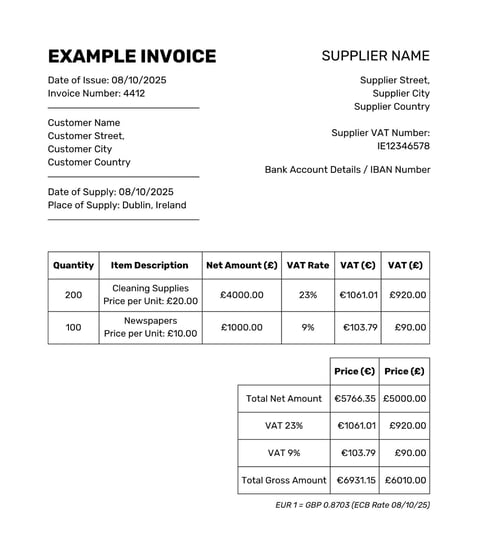
You can issue invoices in any currency, but the VAT amount has to be in Euros. Currency conversions have to be done using the European Central Bank exchange rate on the date the invoice is issued.
Here's an example of a full Irish VAT invoice: